In the world of baking and food processing, the choice of oven directly affects product quality, production efficiency, and operational costs. Two common types of equipment that often stand out in this field are the
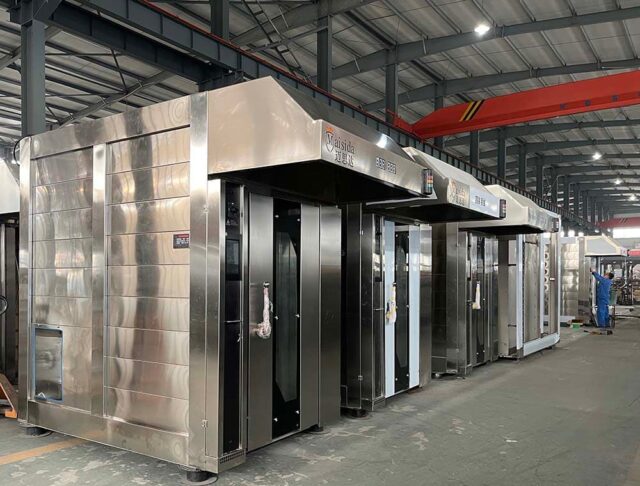
Eco-stone Rotary Oven and the Traditional Oven.
While both serve the core purpose of heating and cooking, their design concepts, working principles, and practical performances differ significantly. This article will conduct a comprehensive comparison of the two, helping businesses and baking enthusiasts make more suitable choices based on their actual needs.
1. Core Design and Working Principle: Innovation vs. Tradition
The fundamental difference between the Eco-stone Rotary Oven and the Traditional Oven lies in their structural design and heat transfer methods, which determine their respective performance characteristics.
1.1 Eco-stone Rotary Oven: Rotational Heating + Eco-stone Energy Storage
As the name suggests, the Eco-stone Rotary Oven integrates two core technologies: rotary baking system and eco-stone inner liner. Its internal baking chamber is equipped with a rotating rack or tray, which drives the food to move slowly during the baking process, ensuring that every part of the food is evenly exposed to the heat source.
The inner wall of the oven is made of high-quality eco-stone (such as natural diatomite or special refractory stone), which has excellent heat storage and heat conduction performance. When the oven is heated, the eco-stone can quickly absorb and store heat, and then release it stably and uniformly in the form of far-infrared radiation, forming a “360-degree all-round heating” environment inside the chamber.
In terms of heat source, most Eco-stone Rotary Ovens adopt energy-saving heating elements (such as infrared heating tubes or gas energy-saving burners) and are equipped with intelligent temperature control systems. They can accurately adjust the temperature and humidity in the chamber according to different food processes, avoiding unnecessary energy waste.
1.2 Traditional Oven: Fixed Heating + Metal Inner Liner
Traditional Ovens (including electric ovens, gas ovens, and ordinary convection ovens) mostly adopt a fixed heating mode. The heat sources are usually distributed on the top, bottom, or side of the baking chamber (such as electric heating tubes or gas burners), and the heat is transferred to the food through heat conduction, convection, and partial radiation.
The inner liner of traditional ovens is generally made of metal materials (such as stainless steel or galvanized sheets), which have fast heat conduction but poor heat storage performance. The heat in the chamber is easily lost when the oven door is opened, and the temperature distribution is prone to unevenness—there may be “hot spots” near the heat source and “cold spots” in the corner areas.
In terms of control, traditional ovens, especially low and medium-end models, have relatively simple temperature control functions, and it is difficult to achieve precise control of humidity, which requires the operator to have rich experience to adjust the baking parameters.
2. Key Performance Comparison: Efficiency, Quality, and Cost
The differences in design and principle directly lead to obvious gaps between the two in core performance indicators such as baking efficiency, product quality, energy consumption, and service life.
2.1 Baking Uniformity and Product Quality: Stable Output vs. Dependent on Operation
Uniform heating is the key to ensuring consistent food quality. For the
Eco-stone Rotary Oven, the combination of rotational movement and eco-stone’s uniform heat radiation ensures that each piece of food (whether it is bread, cake, or pastries) receives the same amount of heat.
This avoids problems such as uneven coloring (e.g., dark top and light bottom of bread), inconsistent texture (e.g., dry outside and wet inside of cakes), and improves the qualification rate of products. The far-infrared radiation generated by eco-stone can also penetrate into the interior of the food, making the food more fluffy and delicious, with a better taste and aroma.
In contrast, the heating uniformity of Traditional Ovens is relatively poor. For example, when baking multiple trays of bread at the same time, the food on the tray close to the heat source is often over-baked, while the food on the tray far from the heat source is under-baked.
Operators need to frequently rotate the trays manually during the baking process, which increases the labor intensity and still cannot completely avoid quality differences. In addition, the dry heat environment of traditional ovens is easy to make the surface of the food hard, affecting the taste.
2.2 Energy Consumption and Environmental Protection: Energy-saving and Eco-friendly vs. High Energy Consumption
Under the background of global emphasis on energy conservation and environmental protection, the energy consumption performance of ovens has become an important consideration for enterprises. The Eco-stone Rotary Oven has obvious advantages in this regard: the eco-stone inner liner can store a large amount of heat, and after reaching the set temperature, the heating element only needs to be intermittent to maintain the temperature.
This energy-saving design can save 30%-50% of energy compared with traditional ovens. At the same time, advanced combustion or heating systems reduce the emission of harmful gases (such as carbon monoxide) and meet the requirements of environmental protection standards.
Traditional Ovens have high energy consumption due to the poor heat storage performance of metal inner liners and unreasonable heat source distribution. The heat loss is serious when the oven door is opened and closed, and the heating element needs to work continuously to maintain the temperature.
This continuous operation results in a large amount of energy waste. Especially for large-scale food processing enterprises that use traditional ovens for long-term continuous production, the accumulated energy costs are quite considerable.
2.3 Durability and Maintenance: Wear-resistant and Low Maintenance vs. High Maintenance Cost
The durability of the oven is related to the long-term operational efficiency of the enterprise. The eco-stone inner liner of the
Eco-stone Rotary Oven has strong high-temperature resistance, wear resistance, and corrosion resistance. It is not easy to deform or rust even under long-term high-temperature operation, and its service life can reach 8-12 years.
The rotating mechanism adopts high-quality bearings and transmission components, which are stable in operation and require only regular lubrication and inspection for maintenance—greatly reducing downtime and maintenance troubles.
The metal inner liner of the Traditional Oven is prone to oxidation, rust, and deformation under high-temperature and humid environments, and the service life is generally 3-5 years—much shorter than that of eco-stone models.
The heating tubes of electric traditional ovens are prone to aging and burning out after long-term use, and the burners of gas traditional ovens are easy to be blocked by oil stains. These issues require frequent replacement and maintenance, which increases the maintenance cost and downtime.
2.4 Applicable Scenarios: Large-scale Production vs. Small-scale Demand
Based on the above performance differences, the two ovens have distinct applicable scenarios. The Eco-stone Rotary Oven is suitable for large-scale and standardized food processing enterprises, such as commercial bakeries, pastry factories, and catering central kitchens.
Its large capacity, high efficiency, and stable quality can meet the needs of continuous mass production, and the energy-saving advantage can effectively reduce the operating costs of enterprises—making it a cost-effective choice for large operations.
Traditional Ovens are more suitable for small-scale users, such as family baking enthusiasts, small dessert shops, and convenience stores. Its structure is simple, the price is low, and it can meet the needs of small-batch, multi-variety baking.
However, for users with large production demand, traditional ovens are difficult to meet the requirements of efficiency and cost control. The frequent manual adjustments and high energy consumption make them less ideal for mass production.
3. How to Choose: Combined with Actual Needs
When choosing between the Eco-stone Rotary Oven and the Traditional Oven, users should comprehensively consider the following factors:
-
Production Scale: If it is large-scale continuous production, the Eco-stone Rotary Oven is the first choice; if it is small-batch occasional use, the Traditional Oven is more economical.
-
Product Quality Requirements: If the product has high requirements on uniformity, taste, and coloring (such as high-end bread and cakes), the Eco-stone Rotary Oven can ensure stable output; if the quality requirements are not high, the Traditional Oven can meet the basic needs.
-
Long-term Operation Cost: Enterprises should calculate the total cost including energy consumption and maintenance. Although the initial investment of the Eco-stone Rotary Oven is higher, the long-term energy-saving and low maintenance costs can bring higher returns.
-
Environmental Protection Requirements: If the region has strict environmental protection policies, the Eco-stone Rotary Oven with low emissions is more in line with the standards.
4. Conclusion
The
Eco-stone Rotary Oven represents the development trend of high-efficiency, energy-saving, and intelligent baking equipment. It has obvious advantages over the Traditional Oven in terms of baking quality, energy consumption, durability, and other aspects.
This makes it especially suitable for large-scale food processing enterprises. However, the Traditional Oven still has its value in small-scale application scenarios due to its low price and simple operation—catering to the needs of hobbyists and small businesses.
With the continuous progress of baking technology and the increasing awareness of energy conservation and environmental protection, the Eco-stone Rotary Oven will gradually occupy a larger market share.
For users, choosing the right oven is not only a purchase decision but also a strategic layout for improving production efficiency and product competitiveness. Matching the oven type to specific needs ensures optimal results and cost savings.