In the commercial baking industry, consistency, efficiency, and scalability are the cornerstones of success. Whether you’re running a small neighborhood bakery or a large-scale food production facility, the right baking equipment can make or break your operations. Among the most reliable and versatile tools in commercial baking is the rotary bakery oven. Designed with a rotating drum that ensures even heat distribution, a rotary bakery oven delivers consistent results across batches, handles high production volumes, and adapts to a wide range of baked goods—from crusty bread and flaky pastries to crispy snacks and sweet treats. This guide explores the core features, working principles, applications, and advantages of a rotary bakery oven, helping you understand why it’s a must-have for modern commercial baking operations.
What Is a Rotary Bakery Oven? Core Definition & Working Principle
A rotary bakery oven is a specialized commercial baking appliance characterized by its cylindrical rotating drum (or chamber) and forced hot air circulation system. Unlike traditional static ovens where baked goods remain stationary, the rotating drum of a rotary bakery oven tumbles or rotates the products gently during the baking process, ensuring every surface is exposed to uniform heat. This unique design eliminates cold spots and uneven browning, a common challenge in static ovens.
The working principle of a rotary bakery oven is straightforward yet effective:
-
Heat Generation: The oven generates heat via electric heating elements, gas burners, or steam (for humid baking needs, such as bread). High-quality models often integrate heat recovery systems to improve energy efficiency.
-
Forced Air Circulation: A powerful fan distributes hot air evenly throughout the rotating drum, ensuring consistent temperature across the entire baking chamber (typically 100°C to 250°C, adjustable for different recipes).
-
Rotating Drum Movement: The drum rotates at a adjustable speed (usually 5-30 RPM), depending on the product type. Fragile items like pastries require slower rotation, while dense goods like bread can handle slightly faster speeds to ensure uniform heat penetration.
-
Baking & Discharge: Baked goods are loaded into the drum (manually or via automated feeders for large-scale operations) and bake as the drum rotates. Once baking is complete, the drum continues to rotate to discharge the products, streamlining the production process.
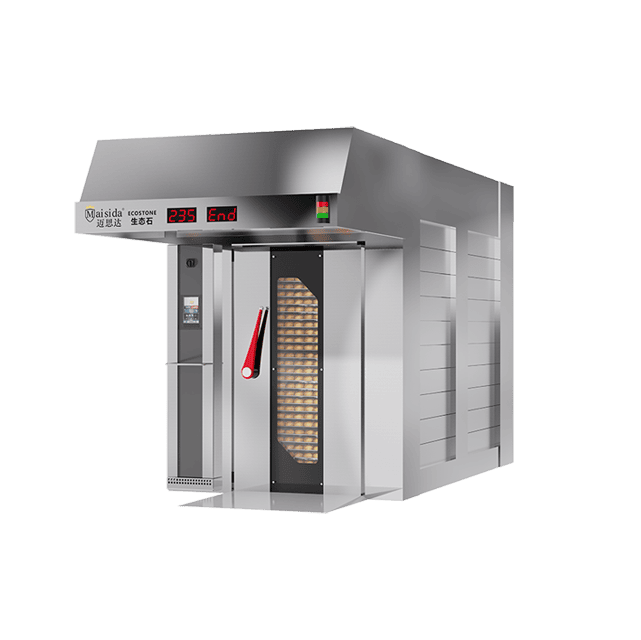
Key Features of a High-Quality Rotary Bakery Oven
Top-tier rotary bakery oven models are engineered to meet the rigorous demands of commercial baking, with features that enhance performance, usability, and durability:
-
Uniform Heat Distribution: Advanced air circulation systems and rotating drum design ensure temperature variation of less than ±5°C, guaranteeing consistent browning and texture across every batch.
-
Adjustable Speed & Temperature: Digital controls allow precise adjustment of drum rotation speed and baking temperature, adapting to different recipes (e.g., 180°C for croissants, 220°C for artisanal bread).
-
High Capacity: Available in various sizes, from compact models (20-50 kg per batch) for small bakeries to industrial-grade units (200-500 kg per batch) for large food factories. Continuous feeding options enable 24/7 production.
-
Energy Efficiency: High-density insulation, heat recovery systems, and efficient burners reduce energy consumption by 15-25% compared to standard static ovens, lowering operational costs.
-
Steam Injection System: Built-in steam injectors for bread and pastry baking, which help develop a crispy crust, retain moisture, and enhance product texture.
-
Durable Construction: Stainless steel drum and frame resist corrosion and high temperatures, ensuring long service life even in high-volume baking environments. Removable drum liners simplify cleaning and maintenance.
-
Safety & Automation: Overheat protection, emergency stop buttons, and automatic temperature monitoring comply with global safety standards (CE, FDA, UL). PLC control systems enable automated baking cycles, reducing human error.
Applications of Rotary Bakery Oven in Commercial Baking
The versatility of a rotary bakery oven makes it indispensable for a wide range of commercial baking applications. It excels at producing:
-
Bread & Rolls: Artisanal bread, white bread, whole-grain bread, hamburger buns, and dinner rolls—benefiting from uniform heat and steam injection for optimal crust and crumb texture.
-
Pastries & Croissants: Flaky croissants, danishes, puff pastries, and turnovers—slow rotation speed preserves delicate layers, while even heat ensures golden browning.
-
Snacks & Cookies: Crispy cookies, crackers, pretzels, and savory snacks—high-temperature baking with consistent heat ensures uniform crispness without burning.
-
Cakes & Muffins: Moist cakes, muffins, and cupcakes—gentle rotation and controlled heat prevent uneven rising, resulting in consistent texture and shape.
-
Specialty Baked Goods: Gluten-free products, organic baked goods, and ethnic specialties (e.g., naan, pita bread)—adjustable settings accommodate unique recipe requirements.
From small bakeries and cafes to large-scale food processing plants, a rotary bakery oven adapts to different production scales and product portfolios, making it a versatile investment.
Advantages of Using a Rotary Bakery Oven for Commercial Operations
Compared to traditional static ovens, a rotary bakery oven offers numerous advantages that boost operational efficiency and product quality:
-
Consistent Batch Quality: Eliminates cold spots and uneven baking, ensuring every product in a batch has the same texture, color, and taste—critical for building customer trust and brand reputation.
-
Higher Production Efficiency: Rotating drum design allows for continuous feeding and discharge, reducing downtime between batches. Industrial models can handle up to 500 kg of baked goods per hour, meeting high-volume demands.
-
Energy & Cost Savings: Energy-efficient design reduces utility costs, while durable construction minimizes maintenance and replacement expenses. Automated controls also reduce labor costs by simplifying operations.
-
Versatility: Adapts to a wide range of baked goods, eliminating the need for multiple specialized ovens—saving space and equipment investment.
-
Easy to Operate & Maintain: Digital controls and automated features simplify operation, even for less experienced staff. Removable components and accessible heating elements make cleaning and maintenance quick and easy.
How to Choose the Right Rotary Bakery Oven for Your Business
Selecting the optimal rotary bakery oven depends on your production needs, product type, and operational constraints. Consider the following factors:
-
Production Capacity: Assess your daily/weekly baking volume. Small bakeries (10-50 kg per batch) can opt for compact models, while large factories need industrial-grade units with high continuous capacity.
-
Energy Source: Choose electric rotary bakery oven for emission-free operations (ideal for urban areas with strict environmental regulations) or gas models for cost-effective high-volume baking.
-
Product Type: Ensure the oven supports your recipe requirements. For example, bread bakeries need steam injection, while cookie producers may prioritize high-temperature precision.
-
Space Availability: Measure your bakery/facility space to select a model that fits. Compact rotary bakery oven designs are available for small kitchens, while industrial models may require dedicated floor space.
-
Safety & Compliance: Verify that the oven meets local safety and hygiene standards (FDA for food contact, CE for European markets) to avoid regulatory issues.
-
After-Sales Support: Choose a manufacturer that offers installation, training, spare parts, and 24/7 technical support—minimizing downtime in case of equipment issues.
By choosing the right rotary bakery oven—aligned with your production capacity, product type, and operational needs—you can elevate your baking operations, meet customer demands, and stay competitive in the dynamic commercial baking industry. Invest in a high-quality rotary bakery oven today and unlock the full potential of your bakery or food production facility.